Singapore

  • Baby expo2022In Singapore (July 2022): Parents-to-be in talks with Cordlife staff on the company's services relating to the storing of baby's cord blood and umbilical cord, etc. Singapore is the No.1 market for Cordlife.
    There was a strong tailwind for Cordlife Group in 2H2022 as Covid restriction measures were lifted, allowing for large-scale events where Cordlife could engage with potential customers.

    Mid-2022 sign-ups for its cordblood banking etc services translated into higher revenue in 2H2022 versus 1H2022 as customers delivered babies (chart below).

    That happy turnaround looks set to extend into 2023 as Cordlife plans to participate in many more baby expos and the like in various markets. 

    CEO CFO23"We've mentioned many times that the penetration rate of cord blood banking, our core business, is not high other than in Singapore, which is our major market. That's why when Omicron hit us in the first half of last year, our P&L was affected quite drastically," said CEO Tan Poh Lan at an investor briefing this week. 

    "The thing is we are very clear: the market is there, there are people who can afford our services and our challenge is how to encourage that."

    The revenue contributions from various markets are shown in the graphic below. Of note, Hong Kong is now a promising market as its border with China has reopened, said Ms Tan. 

    The re-opening enables mainlanders with one parent being a Hongkonger to head back to Hong Kong to deliver their babies, as they had been inclined to do pre-pandemic.

    That's why in 2019, Hong Kong contributed S$9.3 million revenue, far above the S$7.3 million in 2022.

    markets2.23Cord blood banking is the process of storing your child’s umbilical cord blood, which is a rich source of stem cells, should the need for a stem cell transplant ever arise. Cord blood can be used to treat over 85 types of diseases such as leukaemia, lymphoma and thalassaemia, as well as metabolic and immune disorders. Cord blood is particularly rich in Haematopoietic Stem Cells (HSCs), which are responsible for replenishing blood and regenerating the immune system. HSCs are known as ‘precursor cells’ as they have the unique ability to differentiate into the different types of cells found in the body.

    Here's a snapshot of how things went in 2022 for Cordlife: 

    2H2022 rev

    With revenue boosted in 2H2022, that half year's net profit, accordingly, rose too to $3 million (1H2022: $1.9 million).

    Compared to full-year FY2021, the FY2022 profit was down 20.4% because of drops in revenue and gross margin (see chart), the latter due to inflationary costs. 

    netprofit2022

    Stock price 

    35.5 c

    52-week range

    29 - 42 c

    PE 

    18.6

    Market cap

    S$90.9 m

    Net cash  S$79.3 m

    Dividend 
    yield 

    --

    1-year return

    -1.4%

    Source: Yahoo!

    Of note, Cordlife had S$79.3 million net cash (+S$4.7m from 31 Dec 2021) on its balance sheet as of end-2022.

    It has held back from paying a dividend for 2022, likely in view of a M&A possibility.

    For more, see Cordlife's Powerpoint deck here

  • Nordic Group, a SGX-Mainboard listed company, was chosen to be among 200 public listed companies in the Forbes Asia 2022’s “Best Under A Billion” list, which identified excellent companies with annual revenues under US$1 billion. (More on Nordic at the bottom of this page)
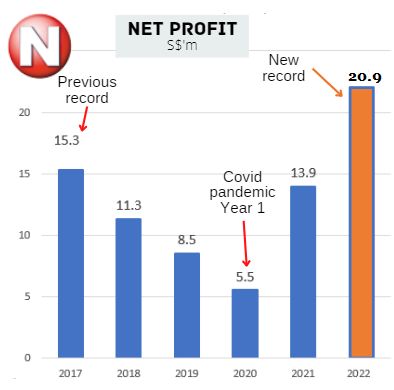
    track r2.23Nordic Group had record profit in 2022 and is set to pay out dividends post-AGM on April 24 that will add up to be a record (final dividend: 0.906 cents/share). 

    The payout ratio is 40%, as in recent years.
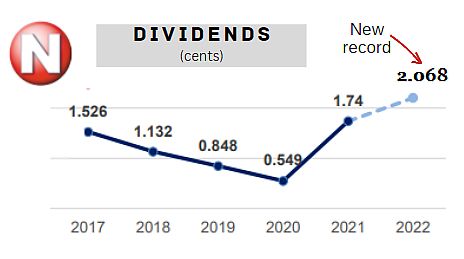
    Dividends r2.23

    Nordic management held a Q&A session with investors last week, excerpts of which are presented below. One key takeaway: There are no near-term big risks faced by the company.

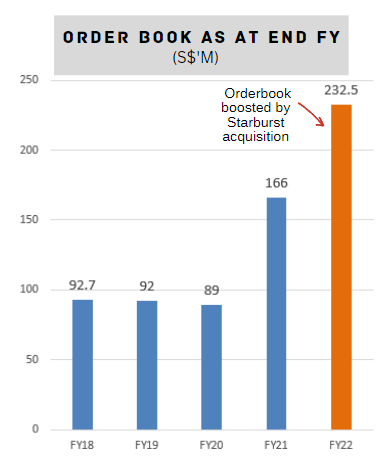
    Instead it stands poised for a good year ahead given its record outstanding orderbook of S$233 million (as at end-2022) which is exposed to diverse industries.

    Look out for the contribution of superior profit margins from Starburst which was acquired in early 2022.

    Notably, the acquisition was non-dilutive as it was an all-cash $59.1 million purchase -- the biggest of Nordic's 5 M&A deals to date -- and so the deal didn't result in a greater number of Nordic shares on issue.

     
    orderbook4.23

    Q: The sharp increase in revenue in FY2022 was said to be because of acquisition of Starburst and Eratech and increase in project services from Malaysia. Is the increase in project services from Malaysia mainly from the semiconductor industry? Is this business segment not affected at all by the semiconductor industry downturn?


    chia meng ru 2CFO Chia Meng Ru: The increase in Malaysia is from semicon industry, and the project contracts were awarded in 2021 and 2022 for the construction ofnew plants. 

    These projects will be finished in 2023 and 2024. After completion, we should have opportunities for maintenance jobs and maintenance of the systems that we built. 

     Q: How about contributions from the rest of the other key business segments? Are they growing or declining?

     
    CFO Chia Meng Ru: From the colorful charts, you can see that everybody is still contributing about the same percentage as per the previous year.
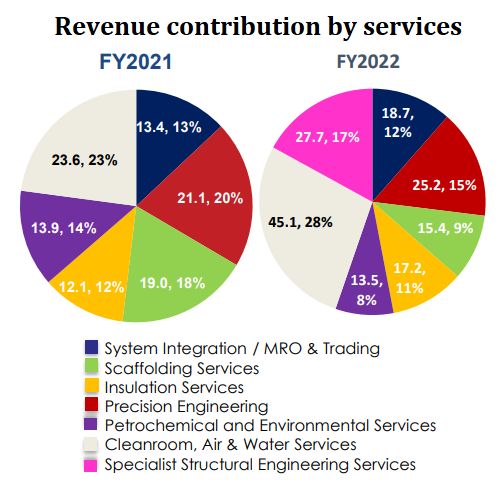
    Revenue contributors2022"Specialist Structural Engineering Services" refers to Starburst contracts.


     Q: With the rapid rise in interest rates, would the company prioritize reducing its bank loans instead of making acquisitions so as to reduce its gearing and significant interest expense?


    Stock price

    46 c

    52-week range

    37.5 – 58 c

    PE (ttm)

    8.6

    Market cap

    S$184 m

    Shares outstanding

    400 m

    Dividend 
    yield 
    (ttm)

    4.5%

    1-year return

    7%


    CFO Chia Meng Ru: We have already reduced the net debt from $35.1 million to $16.2 million. We are planning to pay off more loans in 2023.  

    With our EBITDA at $32 million per year, we should be in net cash quite soon if we don't buy anything else.


     Q: There are about $3.5 million of intangible assets as at end FY2022. Will this be fully amortized by next year?

     
    CFO Chia Meng Ru: These intangible assets are related to the customer order backlog from the Starburst acquisition mainly. The remaining amount will be amortized over eight years, which is the length of the maintenance contracts.


     Q: Given the weak semiconductor industry and dropping oil prices, do you foresee any drop in Nordic’s 2023 revenue?

     
    CFO Chia Meng Ru: Our 2023 revenue will mainly derive from fulfilling the contracts we have secured in our order book now at $232.5 million. The weaker semiconductor industry will not affect our 2023 revenue. 
    And part of 2024 is also secured already.


     Q: Given your orderbook, what is the risk that the contracts will not be executed? 

     
    Executive Chairman Chang Yeh Hong: The projects we have secured are all locked-in projects and mostly projects for new plants. 
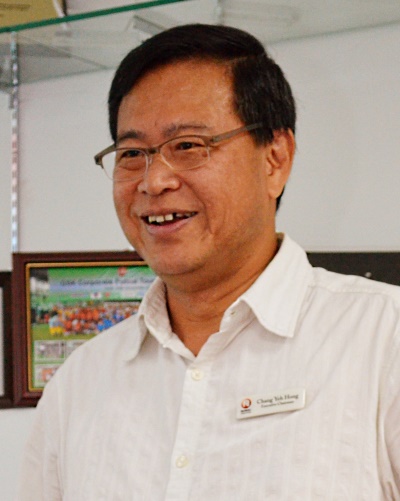
    ChangYehHong 8.15 It's unlikely they will drop off. These are all big multinationals --  our customer base are mostly blue chips and oil companies and semiconductor players. So it's unlikely that they will fall short in funding the projects.

    As for the maintenance segment, it is also safe in the sense that the plants have billions of dollars invested already. They need to be maintained.


     Q: What about competitors?


    Executive Chairman Chang Yeh Hong:There always will be competitors, right? What is more critical is how long have we been entrenched with the clients. Most of our maintenance contracts are more than 20 years. The track record is there and they continue with us if our price is right.

    We just got a maintenance contract for about $12 million from an oil major and we have been with this client for more than 20 years for two services. This time, they decided to combine the services into 1 package -- scaffolding, insulation and painting services. In the past, we got scaffolding on its own and installation on its own.

     Q: What are the greatest risks of your business?


    Executive Chairman Chang Yeh Hong:The greatest risk now is not related to the contracts that we have secured. Rather, it's inflationary pressures, particularly on labor and material. In services, the labor cost is critical to us, their dorm cost is critical to us because we have to house them.

    W
    e are very concerned about that but having said that, some of our businesses' margins are stable and unless inflationary pressures get out of hand I still think we will maintain our profitability provided we continue to get more contracts and it spreads the overhead costs.

    The FY2022 Powerpoint deck is here.  

    Nordic provides system integration solutions, repair and overhaul (MRO), precision engineering, scaffolding and insulation services, petrochemical and environmental engineering services and cleanroom, air and water engineering services. And there is Starburst, which has capital projects and maintenance contracts for the design, fabrication, installation and maintenance of anti-ricochet ballistic protection systems used in shooting ranges and tactical training mock-ups for the security industry in Singapore and Middle East.

  • An open letterfrom George Morgan, CFA, an investor, to Rex International was recently published in The Business Times, following which Rex management's response, signed off by executive chairman Dan Brostrom, was published. 
    Excerpts:  


    chart4.23Chart: Yahoo!

    George Morgan: As a long-term shareholder of Rex International, I would like to add my voice to those who have categorically deplored the company’s diversification into loss-making, non-oil and gas-related businesses through acquisitions of shares from family members of management.

    Like the vast majority of shareholders, I have no interest whatsoever in these types of unlisted investments in drones and biotech businesses. But, if I had, I would invest through a professional venture capital manager with a proven track record who selects portfolio companies from a broad universe of startups rather than just from his family members’ businesses. 

    Rex: Rex International Holding has been and will be in the oil and gas space for many years to come, and will continue to develop its portfolio of assets.

    250 2dan brostromDan Brostrom, executive chairman of Rex International.Its latest addition was at the end of 2022 with the acquisition of a 10 per cent working interest in the producing Yme Field in Norway.

    The group is now producing more than 9,000 barrels per day. This does not speak to inactiveness. Our targets for 2023 to 2024 are to increase our production and reserves. New drillings and additional acquisitions of oil and gas assets are being evaluated.

     
    George Morgan: Even if these (non-oil and gas-related businesses) investments have been carefully constituted to be compliant with the letter of all applicable laws and regulations, this type of behaviour by the management hits rock bottom in the corporate governance spectrum. Not to mention, it is a gross betrayal of shareholders’ trust in them. More simply put, it is unethical.

    Rex: The proposed investment will be tabled for the approval of shareholders at an extraordinary meeting to be convened, at which the interested persons and their associates will abstain from voting. The investment in Moroxite T AB will be at the discretion of the minority shareholders.

    The proposed investment in Moroxite T AB was to seize business opportunities to invest in projects that have unicorn business potential with limited risks, without any material change to the company’s business profile and risks, as a sustainable business diversification strategy, given the volatility in oil prices over the past decade and growing sentiments regarding action against climate change and hydrocarbon exploration and production.

    George Morgan: The company has adequate cash on its balance sheet, claims to be sitting on vast probable and unproven reserves in Oman, and boasts of proprietary technology that gives it a competitive edge in oil and gas exploration. So why not use that technology to find more oil to supplement the rapidly depleting proven reserves there?

    After years of doing only exploration and acting as a non-operating minority partner, once it started its own production in Oman, it turned out that the company’s skill base in maintaining steady production was woefully inadequate.

    At the same time, the appalling production stoppages in 2022 when oil was at over US$100 a barrel have never been satisfactorily explained. This seems to indicate a pressing need to upgrade skills and personnel in the production area to ensure that this type of disruption never happens again.

    Rex: The company has a professional team in place to handle exploration and production. We are blessed with a richness in experience and various backgrounds and perspectives.

    oil rig thumbThe production stoppages in Oman have been explained in the company’s 12 press releases over the period of Dec 10, 2022, to Sep 7, 2022, and in the company’s full-year financial results announcement released on Mar 1, 2022.

     
    George Morgan: Finally, the company has a share buyback mandate. With the stock trading at such bargain basement prices, failure to use the mandate now gives the distinct impression that the management doesn’t see value at this level, because worse news is yet to come.

    Rex: Lastly, one point we can concur with Morgan is that we are all interested in a higher share price, and we believe the company to be undervalued.

  • Excerpts from DBS Research report


    Analysts: Jason SUM, CFA, Tabitha FOO & Paul YONG

    Flying under investors’ radars
    • Aviation sector underperformed the market in the past month after mixed earnings performance

    • Earnings outlook for the sector remains upbeat; earnings inflection imminent for STE (ST Engineering) and SIAEC(SIA Engineering Company)

    • Time to go long as improving fundamentals yet to be reflected in share prices and valuations

    STE and SIA (Singapore Airlines) are our top picks in the sector

    SQ2.15SIA: Target price S$6.80


    Upbeat on sector’s earnings prospects despite macroeconomic concerns. Our optimistic outlook on the aviation sector was reinforced by the latest earnings season, which saw a noticeable change in the tone of management commentary, and companies expressing more optimism on the recovery trajectory.

    Singapore Airlines’ (SIA) impressive earnings momentum appears to be sustainable for a while, while ST Engineering (STE) and SIA Engineering (SIAEC) are well-positioned to see an inflection in earnings as MRO demand accelerates with airlines eager to clear the backlog of deferred maintenance and the normalisation of global flight activity.

    Attractive entry points

    We are confident that the sector will deliver strong earnings growth over the next few years. Current share price levels are attractive entry points with favourable risk-to-reward.”

    Although investors may be wary of the sector due to its high sensitivity to changes in macroeconomic growth outlook amid tightening financial conditions, we remain constructive due to the nascent recovery in Asia Pacific and promising forward booking data.

    With several tailwinds in play, we are confident that the sector will deliver strong earnings growth over the next few years.

    Current share price levels are attractive entry points with favourable risk-to-reward.

    SIA aside, the performance of Singapore aviation counters has fallen behind the broader market over the past six months primarily due to underwhelming earnings.

    We believe that this is unwarranted and suggest that investors should not be deterred by this quarter’s results, as the earnings outlook for the sector remains promising. Additionally, we see buying opportunities as valuations are now more enticing following the share price corrections in the past month.

    STE is our preferred choice in the sector, with the group’s earnings expected to grow at a solid 14% CAGR over the next two years, and undemanding valuation at a forward P/E of 18.6x, which is at around the -1.2 standard deviation level.

    Additionally, we also like SIA, as the airline’s valuation remains undemanding, and we believe that the street is still severely underestimating the airline’s earnings potential.

    SIAEC should make a strong comeback to profitability from 1HFY24, but our optimism towards the stock is somewhat tempered due to its valuation compared to industry peers.


    Full report here

  • Excerpts from DBS report

    China was the number one source market for travel for most countries in Asia. As the largest source market for travel globally before the pandemic, the return of Chinese travellers in 2023 will be the next boost for travel-related sectors in 2023.

    Forward-leading indicators show that Chinese travel demand recovery will be fast, wide, and furious, albeit from a low recovery base.

    Pent-up travel demand will spillover to neighbouring APAC countries such as South Korea, Japan, and Vietnam, where China was the number one source market making up c.30%-35% of the total inbound market as well as leisure-positioned destinations in the likes of Maldives.

     
    GrandCopthorne4.23Grand Copthorne Waterfront Hotel is part of the CDL Hospitality Trusts. The 574-room hotel is situated on the banks of the historic Singapore River and close to the Central Business District.

    Hotel S-REITs have a c.77% exposure to China-positioned travel markets. A recent Chinese travel sentiment survey showed that 84% of respondents intend to travel outside Mainland China within two years of the country’s reopening, with 9 out of the top 10 destinations falling within the APAC region.

    Recovering DPUs

    “Our bull case scenario could see sector DPUs recovering to c.106% of normalised levels in FY24F, which will more than compensate for higher interest rate risks.”

    -- DBS Research

    Our hotel S-REITs have geographical exposure in 6 out of the top 10 China-destination markets, of which Singapore, Australia, and Japan have the largest exposures at c.56%, 10%, and 7%, respectively.

    We expect Chinese outbound tourism to stage a meaningful recovery in most of our S-REIT markets, given a combined exposure of c.77% to the top 10 China-destination markets will see Chinese demand as a key growth driver amongst our S-REITs for 2H23.

    Recovery tracking ahead of our base case trajectory with a c.8.1% forward FY24F sector yield on our bull case forecast. We saw that the sector’s RevPAR recovery was already at c.94% of 2019 levels last year, ahead of our base case scenario.

    Our bull case scenario could see sector DPUs recovering to c.106% of normalised levels in FY24F, which will more than compensate for higher interest rate risks.

    While investor sentiment could be constrained by recessionary risks on the horizon, the impact is less than feared, with a positive correlation of 0.2 to sector operating metrics, while subdued room supply in the market will be key to maintaining sky-high rates in the coming years.

    Prefer CLAS (Capitaland Ascott Trust) and CDREIT (CDL Hospital Trusts) within the sector to ride on global recovery and sustenance of high RevPAR.

    Full report here. 

  • Singapore Reopening Beneficiaries

    Narrowing our focus

    • Feb 13 marks the end of pandemic restrictions – removal of mandatory mask-wearing, shift to Dorscon Green, cessation of the multi-ministry task force – highlights the receding threat of COVID-19 in Singapore.

    • While the news is unlikely a gamechanger for tourist arrivals and retail sales, it nevertheless completes Singapore’s transition to normalcy.

    º Passenger traffic at Changi Airport has recovered to 80% of pre-COVID.

    º Further recovery should take hold with the return of HK/CN tourists -> They made up c.21% of visitor arrivals in 2019.

    at changiSIA had S$17.5 billion cash versus S$15.8 billion total debt as of end-Sept 2022.

    Transition to Dorscon Green comes a day before Budget 2023 (on 14th Feb).

    º COVID relief measures for businesses may not be extended, focus may turn to stimulating post-COVID economic activity and/or tackling inflation.

    We continue to be positive on reopening beneficiaries but narrow our focus on those in net cash position given the increased odds for FED funds rates to peak a notch above 5% and remain around 5% through 2023.

    º Aviation-related: SIA, SIA Engineering
    º Tourism-related: Genting Singapore, Raffles Medical
    º Public transport: ComfortDelGro

    taxis CDG4.22As at end-Sept 2022, ComfortDelGro had net cash of S$647 million.

  • • Singapore-listed Trendlines Group invents, incubates, and invests in medtech and agrifood technology companies in Israel and Singapore. 

    • In Nov 2022, Trendlines announced it would shift gears for 2023 (see: ""). This week, in an online session, Trendlines management took questions from investors on a range of topics including impending exits by portfolio companies. 


    • The 1-hour online session also saw management presentations into the ground-breaking work of several portfolio companies and a review of FY2022 performance of the group. Catch all that at: 


    Below are excerpts of the Q&A, which have been edited for brevity: 

    Q: What's the game plan for this year, how many exits are we targeting?


    ToddDollinger11.20Todd Dollinger, Co-Chairman & Co-CEO, Trendlines GroupTodd: We have a large portfolio of 56 companies today. We have a larger percentage of more mature, more experienced companies today than we have ever seen and we feel that to be
    most productive these companies require more of our effort in helping them mature and bring them to revenues and bring them before investors and the strategic partners that will acquire these companies this year and in the years ahead.

    Steve: We have many companies that are in revenue today. Todd talked about Arcuro’s sales in the first quarter of this year are probably greater than their sales for all of last year.

    Steve RhodesSteve Rhodes, Co-Chairman & Co-CEO, Trendlines Group.Similarly on the agritech side, we have companies that are expecting to do sales of two and three times more than they did last year. Just one example: Sol Chip which in 2021 had US$65,000 of sales, in 2022 had $500,000 and in 2023 expects sales of US$1.5-2.5 million.

    Companies growing like that brings us closer and closer to exits. We can't of course 
    predict when those exits will occur as they're up to the market, they're up to the buyers.

    But I can say with confidence that we are in talks all the time with the market. Todd was in the States recently speaking with major multinational companies and exposing them to selected portfolio companies.

    We're pushing very hard for exits and I think that we're going to see significant exit activity in the next couple of years which will then enable us to distribute dividends as we've promised.


    Todd: We put a tremendous amount of effort into properly positioning companies for sale and for sale at what we believe to be appropriate value producing prices. That's why we attend conferences, we visit with our strategic partners around the world.

    In fact, I'm off again tomorrow on a trip that'll take me to Canada and Singapore, and we'll be meeting with some of the biggest medical device companies in the world during the course of these visits.

    Q: How does Trendlines see the current startup funding winter going? How will the company position itself in the near to medium term?


    Steve: The truth is that up until now we have not seen a significant decline in investment activity in our portfolio companies. Our company Viaqua closed an investment around just two weeks ago. Another one of our medical device companies is closing a round this week.

    We've encouraged all of our portfolio companies to both look at their expense structure to make sure that they can extend their runway on the one hand and on the other to begin their fundraising activities earlier because we believe it could take longer to raise capital.
     

    Todd: It's a really interesting question and there are two key factors that address the inquirer’s thought -- one is the ability to raise and the second is valuations.

    Trendlines fits in a very interesting niche in the investment world. As you know we don't raise money for companies at multi-billion dollar valuations, we are startup specialists and we work on growing those companies. We've actually never raised money at valuations even in the hundreds of millions of dollars much less billions of dollars.

    When you're talking about raises and valuations of 10 million, 20 million, 30 million dollars there is, in difficult times, less downward pressure on the valuations. As well, we see continuing availability of capital.

    Take a look at what we've achieved during down years (see chart below) and first of all you see we continue to raise more money each year than the year before. This has been a constant threat for a number of years now and the valuations are increasing.

    Funds raised3.23


    Stock price

    9.4 c

    52-week
    range

    8.1 – 11 cts

    PE (ttm)

    --

    Market cap

    S$84 m

    Shares outstanding

    895 m

    Dividend 
    yield 
    (ttm)

    --

    1-year return

    -13%

    Source: Yahoo!

    So who gets battered during these tough times?  The companies that go out and raise a billion dollar, multi-billion dollar valuations. They wind up losing 80, 90% of their value in some cases.

    We, on the other hand, see on average valuations increasing and the total amount of funding increasing. I realize that's a bit counter-intuitive but that’s what our numbers are.

    We anticipate a good year this year even in these confusing market times and confusing political times internationally and domestically.

    Trendlines' presentation deck is here. 


  • Reflecting investors' desire for greater disclosure, The Trendlines Group has now offered previously unavailable information on its portfolio companies.

    In its just-released FY2022 annual report, Trendlines -- which invents, incubates, and invests in medtech and agrifood technology companies in Israel and Singapore -- has:

    • categorized its portfolio of 56 companies into 12 “clusters” of companies based on the nature of their business activities.

    • revealed the total value of Trendlines’ share of each cluster, using the IFRS (International Financial Reporting Standards) fair market value as reported in its financial statements.

    • shared non-IFRS information for the clusters.


    SteveTodd3.18Steve Rhodes (left) and Todd Dollinger enjoying a meal of nasi lemak in Singapore. File photo."We use this non-IFRS information internally to assess our business as well as for internal strategic decision-making and identifying future impact our portfolio companies may have on our results," wrote Todd Dollinger and Steve Rhodes, who are co-Chair and co-CEO of Trendlines, which is listed on the Singapore Exchange.

    "The values do not represent any forecast or future performance, but rather as an extra aid for the reader in understanding our view of our portfolio companies. Given our use of non-IFRS information, we believe that such information may be important to investors as seen through the eyes of management."

    The fair market value of the Trendlines portfolio as at 31 December 2022 was US$89.8 million, while the non-IFRS measurement was US$146.6 million.

    Compare that with its market cap of just S$74 million or US$55 million.

    Stock price

    8.3 c

    52-week
    range

    8.1 – 11 cts

    PE (ttm)

    --

    Market cap

    S$74 m

    Shares outstanding

    895 m

    Dividend 
    yield 
    (ttm)

    --

    1-year return

    -17%

    Source: Yahoo!

    Notably, in the non-IFRS measurement the valuation discount that Trendlines applies to the value of ordinary share holdings is eliminated.

    "While this discount correctly represents the fair value of our holdings in the portfolio companies, our experience to date from our previous 10 exits, has been that the valuations of the ordinary shares upon exit were large enough to eliminate the discounts in relation to the preferred shares."

    On the key work ahead, Trendlines reiterated its strategic plan for 2023 which it announced in November 2022, which is to help its advanced stage portfolio companies realize significant exits.

    See: 


    Since Trendlines' listing in 2015, its portfolio value has grown from US$57.2 million to US$89.8 million and generated an additional US$49.4 million in exit proceeds from the portfolio.

    Another interesting vignette from the annual report is the list of Top 20 shareholders, with Robert Stone appearing for the first time there.

    His holding is worth north of S$2.2 million currently.

    annualreport2022 top20Annual report 2022

    Robert Stone is a familiar name to investors who are into Singapore-listed stocks such as China Sunsine and Dutech Holdings as he is/was a Top 20 shareholder in a number of companies. (See: 
    )

    Also among the Top 20 in Trendlines is Wang Yu Huei (aka Alan Wang) with 10.4 million shares -- he is a Top 20 shareholder in numerous other companies.

    He is MD and controlling shareholder of his investment vehicle, Asdew Acquisitions (18.4 million shares of Trendlines). 

    These shareholdings are unchanged compared to the annual report 2021.

    Also continuing to maintain its holdings is Morph Investments, a low-profile value-oriented fund which also appears in the Top 20 shareholder lists of several companies.


    The 2022 annual report is here.


We have 1298 guests and no members online

rss_2 NextInsight - Latest News