

|
Nordic Group’s 3Q2026 results were already encouraging: revenue rose 13% year on year while net profit climbed 31%, taking 9M2026 profit to S$15.8 million. The subsequent management briefing provided a more interesting look at what could drive the engineering group in 2027 and beyond.
At the same time, in some businesses, the problem is no longer finding orders—it is having enough manpower, equipment and execution capacity to take them on. Here are eight things that stood out from the briefing: |
| 1. Management is signalling strong FY26 profit |
Management said FY26 revenue could exceed the previous annual high of about S$162m.
More importantly, Executive Chairman Chang Yeh Hong again raised the prospect of a special dividend if indeed 4Q lifts Nordic to a strong full-year profit.
That would come on top of Nordic’s existing policy of distributing 40% of earnings.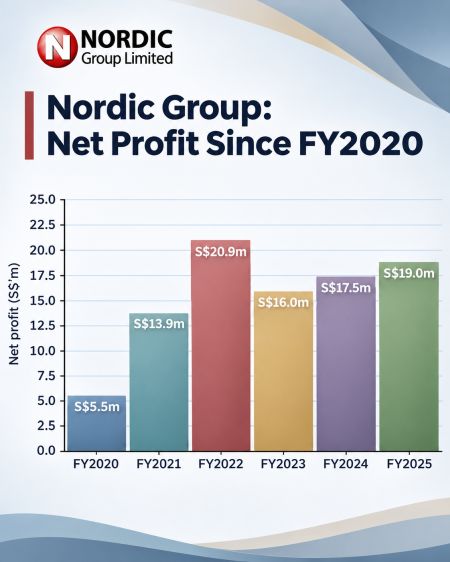 For illustration, if Nordic's 4Q profit matches the 3Q figure of $5.8 million, the total FY26 net profit will reach a record S$21.6 m. Then, on 50 cent stock price:
• FY26 P/E: 9.2x
• Ordinary dividend: 2.17 cents (40% payout)
• Dividend yield: 4.34%, excluding any special dividend.
2. Cash generation is solid
Nordic’s net cash had already reached S$20.1 million at end-Sept, versus just S$4.1 million at end-2025, and should rise further in 4Q because there are fewer scheduled major cash outflows.
More strikingly, Mr Chang said that, absent major acquisitions or capital expenditure, Nordic could add around S$30 million of cash a year.
That means Nordic will have a capital-allocation problem of the good kind: how much to spend on capacity, acquisitions, dividends or share buybacks.
Management's preferred order appears to be:
- Invest in capacity where returns are attractive.
- Pursue acquisitions only if clearly accretive.
- Otherwise return excess cash.
| 3. Marine segment looks particularly strong |
Mr Chang described the current shipbuilding cycle as a “golden era” potentially lasting another five to six years.
Nordic recently secured work on 51 vessels from a single Chinese shipyard, illustrating the scale of series-vessel ordering now taking place.
Nordic supplies automation, flow-control and monitoring systems.
For FPSOs (Floating Production, Storage and Offloading vessels), the engineering work is considerably more complex.
When existing vessels are converted into floating oil production facilities, Nordic may need to redesign, upgrade and integrate existing control systems to meet new operational requirements.
Once installed, these systems also generate opportunities for higher-margin replacement parts, repairs and servicing throughout the vessel's operating life.
Mr Chang put it simply:
“What we want is really the FPSO conversions… because the margins are really good.”
He added that 2–3 FPSOs a year would be very good, and the current quoted pipeline includes around 11 FPSOs.
That makes marine a strong earnings catalyst.
| 4. Semiconductor: huge opportunity |
The semiconductor/project quotation pipeline has jumped to about S$440m, but only around S$38m is currently classified as having mid-to-high probability of success.
An investor explicitly noticed that the high-conviction proportion has fallen from around 40% previously to under 10% now.
CEO of susbdiary Envipure, Jeanette Lee, explained that many of the new opportunities are very large, early-stage projects of S$30m–70m each.
She said semiconductor customers are in a “super cycle”, with Micron and others expanding simultaneously across Singapore, Malaysia, India, Thailand and Vietnam.
5. Capacity may become the constraint on earnings growth
Nordic effectively said it cannot accept every large semiconductor project because once it commits resources to one major project, it may have to turn down another.
Mr Chang said:
“It's not just getting the contracts but looking at the capability and the timing…”
That's both positive and negative.
- Positive: demand exceeds Nordic's existing capacity.
- Negative: FY27 growth may be constrained by manpower, equipment and execution bandwidth.
| 6. The defence-pipeline fall from S$170m to S$100m is not worrying |
Mr Chang said the pipeline fell because:
- Nordic secured some contracts;
- two projects totalling roughly S$30–40m were abandoned by the end-users; and
- Nordic itself dropped some fuel-tank work because margins were too low and capacity was tight.
The major defence projects also remain alive.
Mr Chang said one major project is now closer to tender award, while the Tengah air-base work is progressing first through A&A/integration work before the larger expansion project.
7. Thailand is real now—and moving fast
AviTools Thailand has now started mass production for the energy-storage programme.
Management expects only about US$0.2m in 4Q26, but around US$5m revenue in FY27 from the current programme.
The customer is asking Nordic to ramp faster than expected, and management says current demand is already straining capacity.
So, the recurring theme is: Demand isn't the problem. Capacity is.
| 8. One concentration risk: Micron |
Management said more than 50–60% of its semiconductor opportunities are from Micron.
Nordic has worked with Micron for more than 40 years, so this is a very strong relationship—but it's still concentration.
The upside is that Nordic has followed Micron into India, winning its first project there, and hopes to build the same local base it previously created in Malaysia.
The outlook appears encouraging. Mr Chang said Nordic’s current order book gives the group more than a year of visibility, and that further major awards during 2027 could stretch that visibility even further.
Importantly, maintenance remains the more predictable and traditionally better-margin side of the business. Nordic is heading into 2027 with a record order book, rising cash, a strong marine cycle, semiconductor customers expanding rapidly, defence opportunities still in play and a new Thailand operation beginning to contribute. |
|||||||||||||||||
 → See the Powerpoint deck here
→ See also: NORDIC GROUP: This Company Has 21% Higher Profit, Record Orders and a Cash Build-up


