

|
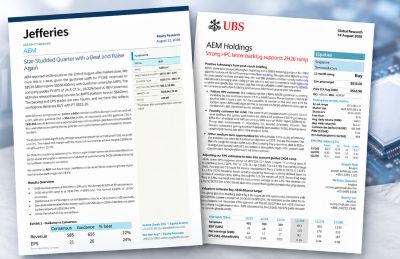
AEM Holdings ($9.32) has already enjoyed a spectacular 440% run this year, but two recent foreign broker reports suggest the story still has a long runway. Jefferies and UBS remain bullish following AEM's strong 2Q2026 results. Jefferies has a buy rating and S$15.20 target price, while UBS has a buy and S$16.00 target. Jefferies' headline captures its enthusiasm: “Star-Studded Quarter with a Beat and Raise Again”. There is growing evidence that its semiconductor-test equipment is becoming increasingly important as AI and high-performance computing (HPC) chips become more powerful — and harder to test. The big number everyone is looking at is AEM's more than S$400 million backlog for its AMPS (Asynchronous, Modular, Parallel, and Smart) platform. |
UBS points out something interesting: that figure is for AMPS alone, rather than AEM's total order book.
In simple terms, AMPS is one of AEM's platforms for stress-testing powerful processors before they leave the factory and end up in servers and other high-performance systems.
The orders come from both the fabless HPC customer (ie a chip designer that outsources manufacturing, which the market speculates to be AMD) and the foundry customer (ie manufacturer of chips for other companies), which UBS identifies as Intel.
The fabless HPC customer is already using AMPS for server CPU and GPU burn-in testing.
UBS expects the high-volume ramp to continue and sees scope for AEM eventually to use AMPS at more test stages for the same customer.
That gives AEM two possible engines of growth: customers producing more powerful chips, and AEM getting a bigger share of the testing work on each chip.
| Intel is becoming interesting again |
UBS says AEM management sounded noticeably more positive about Intel this quarter.
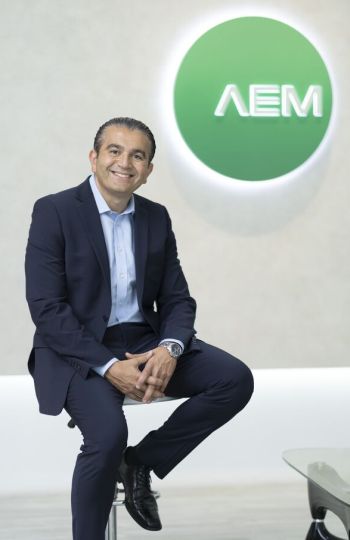 UBS and Jefferies are aligned with AEM CEO Samer Kabbani's important claim: AEM can land a test platform, expand its role at the same customer, and turn that installed position into a much larger earnings stream.Intel designs CPUs for desktops, mobile devices and data centers while its foundry business manufactures chips for other companies such as hyperscalers (giant cloud/data-centre operators such as Amazon, Microsoft and Google).
Orders for AEM's HPST system-level-test platform are picking up, while Intel has also adopted AMPS for future test requirements.
If Intel wins more business manufacturing chips for big cloud operators and companies designing their own custom AI chips, UBS believes that could create more demand for AEM's testing equipment.
So AEM's rebound looks like two major customer-driven engines operating together: the new fabless AI/HPC customer ramping strongly, while Intel starts contributing more.
Jefferies also sees stronger demand ahead, noting that customer demand appears better over the next two years.
| Increased guidance was key |
AEM raised FY2026 revenue guidance to S$630–S$680 million, from S$550–S$600 million previously.
The EPS guidance: 24.5–27.5 cents.
Jefferies says the results give it greater confidence that AEM can reach S$1 billion in annual revenue earlier than previously expected, and potentially achieve margins above its previous 18.8% peak.
UBS provides a possible roadmap:
|
Metric |
FY25 |
FY26E |
FY27E |
|
Revenues (S$m) |
399 |
641 |
950 |
|
EBIT (S$m) |
22 |
103 |
176 |
|
Net earnings (S$m) |
17 |
83 |
142 |
|
EPS (diluted) (S$) |
0.05 |
0.26 |
0.44 |
|
DPS (S$) |
0.01 |
0.06 |
0.09 |
|
Net cash / (debt) (S$m) |
61 |
176 |
175 |
Source: UBS
At S$10.98, UBS estimates AEM trades at 24.7 times FY2027 earnings.
It argues that this represents a discount to both tester suppliers and Southeast Asian semiconductor-equipment peers despite AEM's stronger expected growth.
There are still risks. AEM (market cap: S$3 billion) remains heavily dependent on a very small number of customers, while UBS also flags litigation risk and dependence on key technical personnel. But the AEM story has clearly moved on, as reflected in the brokers' target prices:
Now the orders are arriving, the backlog is visible, Intel is improving and brokers are pencilling in a substantial earnings jump in 2027. |
 → See also: AEM CEO on “Razor-and-Blades” Model Driving Its AI Test Growth


