

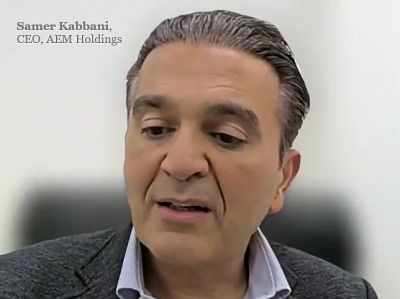
The following is the CEO of AEM's opening remarks at the company's 1H2026 earnings call. Samer Kabbani says that AI is fundamentally changing semiconductor testing — creating not just more chips, but more test time, more complex thermal requirements and more recurring revenue opportunities for AEM. He reveals the heart of AEM's “Follow the Chiplet” strategy: land its platforms with customers, expand the installed base and keep earning from each new generation of devices.
|
Let me begin with what AEM is today. AEM is a global semiconductor test solutions company headquartered in Singapore, operating across seven plus countries with customer relationships built over two decades. We are the leader in advanced thermal control through our unified PiXL platform across burn-in, final test, and system-level test.
AMPS provides high-density slot-based testing for HPC and AI. HPST provides high power, high parallel system level testing. Together with our legacy products, this gives AEM an installed base of more than 1,000 high parallel test solutions across major CPU and GPU suppliers and emerging hyperscalers. |
When we reported Q1, I said the quarter marked the beginning of something structurally significant for AEM. Our first half results strengthened that conviction.
We delivered our fourth consecutive quarter of net profit growth and our third consecutive quarter of revenue growth.
| • Revenue was 247.2 million, up 30% year over year and 18% versus the second-half of 2025. • Profit before tax reached S$38.2 million with a PBT margin of 15.5%, up 13.4 percentage points year over year and 7.2 percentage points half on half. • Diluted EPS rose nearly tenfold to 9.7 cents. |
That is what operating leverage looks like when higher value test solutions scale.
Based on that visibility, we're raising our 2026 guidane for the second time this year, now to the range of S$630 million to S$680 million.
Our AMPS backlog exceeded S$400 million as of today and continues to grow, supported by both AI and HPC fabless customer, as well as PC and Foundry customers.
We're also guiding for full year EPS to 24.5 to 27.5 cents and have declared an interim dividend of 2.4 cents per share.
The message is simple: growth is translating into earnings, and earnings are translating into shareholder returns.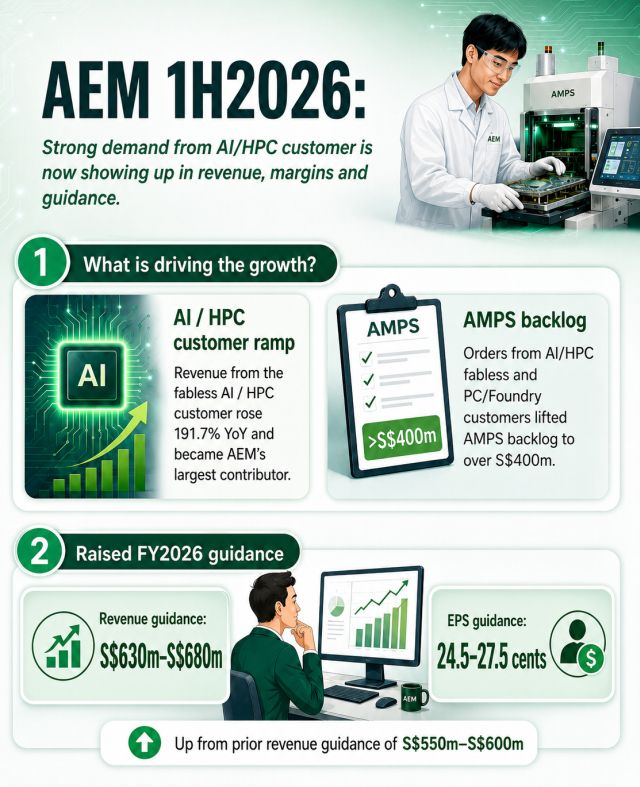 AMPS is AEM’s high-powered semiconductor test platform for AI and HPC chips. AEM describes it as a system for applying high-voltage stress and testing these powerful processors before they are put into actual products.
| Why demand is durable |
The industry backdrop helps explain why we believe the demand is durable.
The data center CPU market is expected to expand from roughly US$26 billion in 2025 to about US$220 billion in 2030, a compound annual growth of more than 50% as AI hosting and agentic workloads grow.
AEM is already a trusted partner for the top two CPU OEMs, delivering high parallel solutions for their most demanding test requirements.
This creates two resilient growth engines for us.
More complex devices take longer to test, increasing the need for test capacity.
And every new device variant requires new device-specific configurables and collaterals.
In other words, AI not only creates more chips, it creates more test per chip and more revenue opportunities per installed base.
Within the broader market, AAM's serviceable addressable market is expected to grow from about US$3 billion in 2026 to about US$4.5 billion in 2028 -- a 50% increase in just two years.
The important point is not the size of the opportunity, but how quickly it is expanding.
This gives us runway that extends well beyond the current customer ramp and product cycles.
Why is the market expanding so quickly?
(At this point, Samer shares graphics to illustrate why test challenges are exponentially increasing in complexity and cost).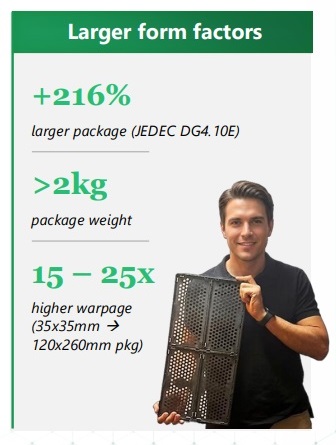
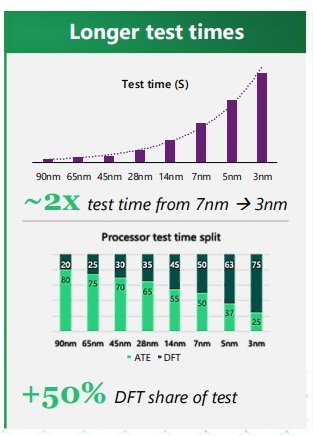
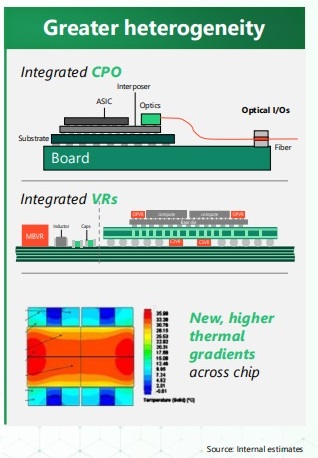
Put simply, we're no longer testing a chip. We're recreating an operating environment of a system inside of a package.
This is exactly what our high parallel thermally advanced platforms were built to do.
This is where our technology strategy and our business model comes together. We call it "follow the chiplet".
Test 1.5 gives us low friction and a way to land. We upgrade customers' existing infrastructure and configurable test slots with instruments and thermal engines.
Once those technologies are qualified, Test 2.0 gives us the path to expand into complete AEM systems and handling solutions such as AMPS, HPST, Xion, and Xact.
The same architecture can now flow across the device, across all test insertions and successive generations.
The installed base is what we call the razor.
Device-specific collaterals, interfaces, and thermal upgrades are the razor blades.
As customers' roadmaps evolve, each device can create follow-on revenue from the installed platform.
We're not simply selling a machine, we're building an installed base that expands with customers' roadmaps.
| Take 5 |
Bringing this together, our five pillars are not separate bets.
There are five routes through which we can apply the same thermal instrumentation and high parallel test capabilities.
• First, PC and foundry.
Our mission here is to expand our installed base with our Test 1.5 upgrades but then capture more challenging future insertions with the Test 2.0 AEM-developed solutions.
• Second, our AI/Fabless customer.
Here, our mission is to sustain high volume ramp and progressively transition more demanding test insertions to AEM-developed solutions.
• Third, memory.
Here, our focus is to complete qualification of our Xact final test handler at our first memory IDM with our first handler planned to be shipped in Q4 ahead of an anticipated production ramp in 2027.
• Fourth, OSATs.
Here, our mission is to expand and capture hyperscaler-driven opportunities by extending Test 1.5 and 2.0 solutions across AI and HPC-focused OSATs, supported by our long-term strategic partnership with ASE.
• Fifth, contract manufacturing. Here, we must scale along AEM's semiconductor ramp and improve profitability as this vertical also provides supply chain resilience for our critical equipment ramp.
|
Across all five pillars, the operating priority is execution. |
 → See also:In His Own Words: AEM CEO's Take on Unprecedented Growth Opportunities In AI Boom
and 1H2026 results PowerPoint deck.


