semiconductor

  • Coming out of 2022, a year of record profit, AEM Holdings stock has been punished for a less-than-optimistic outlook for 2023. DBS, UOB KH and Maybank KE have dismal target prices of $2 and $2.78. $2.66, respectively. However, CGS-CIMB maintained its $3.86 target as it looked to AEM's recovery in 2H2023 and beyond. This aligns with what AEM's CEO, Chandran Nair, said at yesterday's results briefing: 

    Chandran quote2.23


    Below are excerpts from CGS-CIMB report
    Analysts: William Tng, CFA & Izabella Tan

    Looking forward to FY24F
    ■ FY22 revenue of S$870.5m and net profit of S$126.8m were in line with our and Bloomberg consensus full-year expectations.

    ■ AEM believes that global semiconductor revenue could still reach US$1tr by the early-2030s.

    ■ Reiterate Add with a TP of S$3.86.
    Final dividend was lowered to 3.6 Scts (FY21: 5.0 Scts).


    graphic 10.22

    Inevitable FY23F slowdown post a record FY22


    FY22 revenue of S$870.5m (+53.9% yoy) was in line with our/Bloomberg consensus expectations, at 102%/104% of full-year expectations, and exceeded AEM’s own FY22 revenue guidance of S$820m-850m.

    New customers
    "AEM thinks that in FY23F, revenue contribution from three new customers could double from that achieved in FY22."

    Profit before tax margin decreased to 18.2% in FY22 vs.19.7% in FY21 due to increased cost pressure from supply chain challenges and product mix.

    FY22 net profit of S$126.8m (+37.9% yoy) was in line with our/Bloomberg consensus expectations, at 98%/99% of full-year forecasts.

    There was a S$2.0m foreign exchange loss in FY22 due to the decline in the US$ versus the S$, which we had previously factored into our full-year forecasts.

    AEM also slipped into a net debt position with a net gearing ratio of 3.1%, vs. a net cash position in 1H22.


    Initial FY23F revenue guidance of S$500m, cautious on FY23F


    AEM cautioned for a weaker FY23F given the global slowdown, rising interest rates, and weaker consumer demand. Initial FY23F revenue guidance of S$500m is 11% above the upper end of our previous S$350m-450m forecast.

    AEM thinks that in FY23F, revenue contribution from three new customers could double from that achieved in FY22.

    The company is also hopeful that FY24F could see higher production demand from these customers.

    We see a semicon recovery in FY24F after a decline in FY23F

     
    We reduce our FY23F revenue forecast by 10.5% (on concerns over the potential slowdown in FY23F), leading to a 19.3% decline in our EPS forecast.

    We think AEM will benefit from the semiconductor industry recovery in FY24F and hence, maintain our FY24F net profit forecast though EPS increases by 0.1% as the number of shares declined after AEM’s share buybacks in FY22.

    Reiterate Add with unchanged TP of S$3.86   

    williamtng4.14William Tng, CFA.We reiterate Add on potential FY24F earnings recovery (FY23F EPS could drop 29.3% yoy).

    Our TP is still based on 9.5x P/E, 0.5 s.d. above its 6-year average given its sole supplier status with its major customer.

    Re-rating catalysts include stronger-than-expected orders from its major customer and earlier-than-expected success in securing orders from other potential customers.

     
    Downside risks are delivery delays and the loss of its sole supplier status for its major customer, which would negatively affect AEM’s profitability, in our view.

    Full report here. 

  • This is Part 2 of a 2-part report. Part 1: ASMPT: Business segments which buoyed 2022 profit after 2021 supercycle year

    Below are excerpts from a Q&A session during ASMPT's FY2022 results briefing this week (results announcement here). The answers point to a positive near-term and mid-term outlook for ASMPT in terms of orderbook and gross margins as it navigates the current semiconductor downcycle. 


    Entrance10.22

    Gokul Hariharan, JP Morgan analyst:
    Are you starting to see any kind of recovery in bookings in the current quarter for the semiconductor solutions -- we have seen the bookings declined substantially over the last several quarters.

    Are you seeing some encouraging signs from customers Q1 is likely to be the bottom for the semiconductor solutions business?

    And also related to the semi business itself, could you also talk about pricing dynamics?

    You saw encouraging pricing dynamics in 2021 during the super cycle. Is any of that getting reversed right now given you've been able to hold your gross margins pretty steady even while bookings and revenues have declined more than 50% from peak levels. 


    RobinNg new• Robin Ng, CEO, ASMPT:
    We expect group Q-o-Q bookings to increase by maybe 10 to 20%, s
    o Q1 will be higher than Q4 by 10 to 20%. 

    This is largely in line with seasonality trends where Q1 bookings tend to be higher than Q4.

    We see strength still in certain segments like automotive. L
    ikewise I think for industrial segment and advanced packaging.

    The whole industry is hopeful that China will start to recover after lifting its COVID-19 restrictions. We do see some pockets of buying interest so far in Q1 from certain China customers -- for high-end smartphone applications and also automotive. But this is not a sign of a broad-based China recovery.

    We do a lot of channel checking -- with our customer base -- and also look at how industry watchers or independent research houses look at where the semiconductor industry will go from here.

    Feedback from our customers and generally the industry view is that the recovery could begin in the second-half of 2023. And many, many customers of ours who have announced their result also cited that one possible tail wind for this to happen is the positive effect of the Chinese economy from the lifting of the COVID-19 restrictions.

    Katie Xu• Katie Xu, CFO, ASMPT:
    As we have communicated in previous quarters, and as you pointed out, we have increased our price during the supercycle year in a very sensible way, in a very targeted way, and so far we have been able to sustain that pricing level.

    Now of course it's a competitive market and especially for our orders quoted in U.S. dollars because of the US dollar strengthening last year, we had some headwind on the FX side.

    But for equipment sale, pricing is determined by manufacturers, right?

    And the customers do consider our solutions, our strong relationship, our leading technology and our after sales services in a combined way.  The short answer to your question -- from the gross margin performance you can tell that we have been able to sustain the pricing level.

    Kyna Wong, Credit Suisse analyst:
    You mentioned the auto, industrial and advanced packaging momentum continues to stay steady and strong, especially auto. So can we see the gross margin sustain at 40% above level this year?


    • Katie Xu, CFO, ASMPT:
    The group delivered another very solid gross margin quarter, making the 7th consecutive quarter of the margin above 40%.

    To put this into perspective, in the last downcycle, the group's gross margin level was hovering around 35 to 38%. So, we believe there is a step change.

    Now in terms of the sustainability of gross margin, I'd like to look at the drivers of the solid performance, so far. There are three layers:

    One is both semi and SMT gross margins have improved year over year.

    Second, the product mix -- the auto, industrial and AP momentum -- have contributed. Their revenue has become very sizable compared to the group revenue and margins from those end markets and solutions are relatively accretive to the gross margin of the company. 

    Also, I want to point out as we were coming into the downturn, the group has reacted quite timely in terms of cost control measures.

    The measures include, especially on the SEMI side, the sensible hiring only for very critical positions, flexible workforce reduction, and some prioritization of strategic investment, etc. 

    All that, we believe, will be sustainable.

    Having said that, I want to put a pretty large caveat out there. The group's margin is influenced definitely by volume and also the segment mix between SMT and SEMI and lastly, product mix if the mainstream products rebound in a big way.

    I hope I have given you enough color on the gross margin going forward.

    (Q&A content has been edited for brevity and clarity)

  • This is part 1 of a 2-part report. Part 2 is: ASMPT: Q&A on 40% gross margin, semicon recovery

    After the semiconductor industry's super-cycle year 2021, the following year was hit by events including the Russia-Ukraine conflict, ongoing trade tensions, inflation and cautious consumer sentiment in the face of an economic slowdown.

    Stock price 

    HK$72.95

    52-week range

    HK$41.60 – 87.75

    Market cap

    HK$30.1 b

    PE*

    11.5

    Dividend yield* 

    4.4%

    1-year return

    -14.4 %

    Shares outstanding

    412.7 m

    * Based on FY22 EPS $6.36 and HK$3.20 dividend.

    Still, ASMPT’s performance for 2022 actually surpassed pre-pandemic levels, recording its second-highest annual revenue and bookings.

    CEO Robin Ng said at an earnings call this week: "Part of our success was our ability to effectively tap the competitive advantages of our unique and broad-based portfolio of semiconductor and electronics manufacturing solutions.

    "These span mainstream, applicative, and advanced packaging tools, and serve various end-market applications across a global pool of customers. We truly believe our solutions portfolio continues to be a differentiator for us."


    facade2.23

    Reflecting different business cycles, the SEMI segment's revenue fell 25.2% y-o-y while SMT segment grew 9.8%.Regarding ASMPT's unique and broad-based portfolio, the Group’s SMT segment delivered record revenue in 2022, fuelled by strong demand from the Automotive and Industrial end-markets.

    The SMT segment also recorded its highest ever share of contribution to Group bookings in 2022.

    "These developments clearly reflect the resilience of our business model even in a semiconductor downcycle."


    As for the end-markets, with macroeconomic uncertainties and dampened consumer sentiments, the Consumer, Communication and Computer end-markets were weak in 2022.

    However, the Automotive and Advanced Packaging end-markets did well, delivering an aggregate of about 40% of Group revenue for 2022: 

    • The Automotive end-market benefitted from the global transition to electric vehicles and thus counted China's fast-growing EV manufacturers among its customers.

    This end-market enjoyed 20% year-on-year growth in revenue, achieving its highest-ever level of about US$515 million. Automotive also had the highest weightage of Group revenue at about 21%.

    • Advanced Packaging solutions contributed roughly US$500 million in revenue for 2022, or about 20% of total Group revenue.

    Mr Ng said: "The Group is confident of having the industry’s most comprehensive suite of Advanced Packaging solutions across the SEMI and SMT segments."


    Heading into 2023, Automotive and Advanced Packaging set ASMPT's orderbook 
    up well, boosting the total backlog to US$1.15 billion. Most of it will be delivered this year. 

    The Group expects revenue for first quarter of 2023 to be between US$455 million to US$525 million. At mid-point of guidance, this will be a decline of 11.4% quarter-on-quarter.  

    As for dividends, the policy is to maintain payouts of about 50% of Group’s profits on an annual basis.

    For 2022, the Board proposed a final dividend of HK$1.90 per share. Including an interim dividend of HK$1.30 per share, the total payout for 2022 is HK$3.20 per share
    .


    For more on the results, see the Powerpoint deck here

  • Nordic Group, a SGX-Mainboard listed company, was chosen to be among 200 public listed companies in the Forbes Asia 2022’s “Best Under A Billion” list, which identified excellent companies with annual revenues under US$1 billion. (More on Nordic at the bottom of this page)
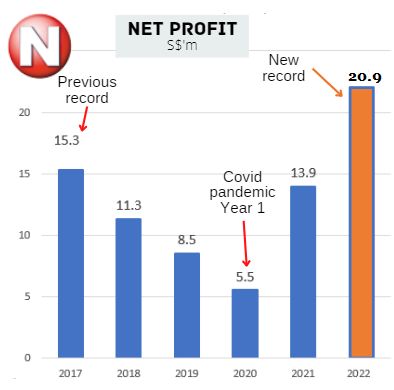
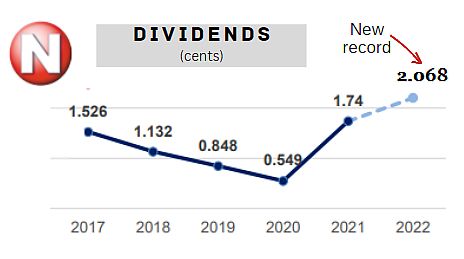
    track r2.23Nordic Group had record profit in 2022 and is set to pay out dividends post-AGM on April 24 that will add up to be a record (final dividend: 0.906 cents/share). 

    The payout ratio is 40%, as in recent years.
    Dividends r2.23

    Nordic management held a Q&A session with investors last week, excerpts of which are presented below. One key takeaway: There are no near-term big risks faced by the company.

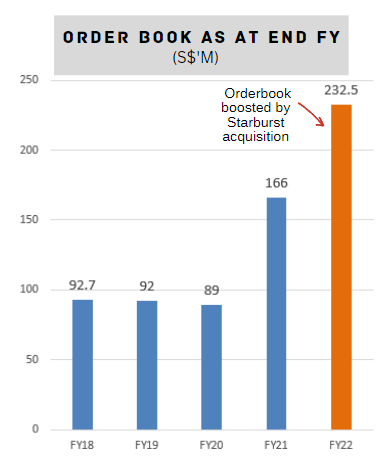
    Instead it stands poised for a good year ahead given its record outstanding orderbook of S$233 million (as at end-2022) which is exposed to diverse industries.

    Look out for the contribution of superior profit margins from Starburst which was acquired in early 2022.

    Notably, the acquisition was non-dilutive as it was an all-cash $59.1 million purchase -- the biggest of Nordic's 5 M&A deals to date -- and so the deal didn't result in a greater number of Nordic shares on issue.

     
    orderbook4.23

    Q: The sharp increase in revenue in FY2022 was said to be because of acquisition of Starburst and Eratech and increase in project services from Malaysia. Is the increase in project services from Malaysia mainly from the semiconductor industry? Is this business segment not affected at all by the semiconductor industry downturn?


    chia meng ru 2CFO Chia Meng Ru: The increase in Malaysia is from semicon industry, and the project contracts were awarded in 2021 and 2022 for the construction ofnew plants. 

    These projects will be finished in 2023 and 2024. After completion, we should have opportunities for maintenance jobs and maintenance of the systems that we built. 

     Q: How about contributions from the rest of the other key business segments? Are they growing or declining?

     
    CFO Chia Meng Ru: From the colorful charts, you can see that everybody is still contributing about the same percentage as per the previous year.
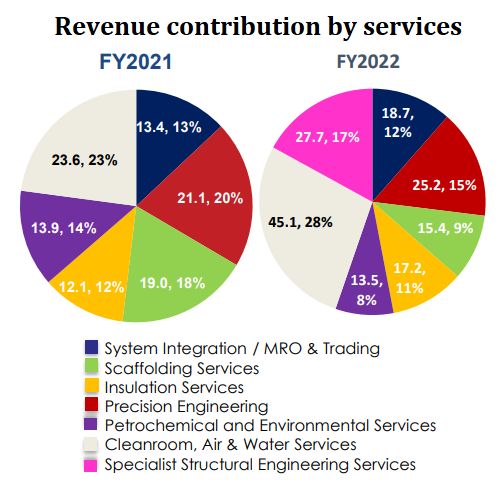
    Revenue contributors2022"Specialist Structural Engineering Services" refers to Starburst contracts.


     Q: With the rapid rise in interest rates, would the company prioritize reducing its bank loans instead of making acquisitions so as to reduce its gearing and significant interest expense?


    Stock price

    46 c

    52-week range

    37.5 – 58 c

    PE (ttm)

    8.6

    Market cap

    S$184 m

    Shares outstanding

    400 m

    Dividend 
    yield 
    (ttm)

    4.5%

    1-year return

    7%


    CFO Chia Meng Ru: We have already reduced the net debt from $35.1 million to $16.2 million. We are planning to pay off more loans in 2023.  

    With our EBITDA at $32 million per year, we should be in net cash quite soon if we don't buy anything else.


     Q: There are about $3.5 million of intangible assets as at end FY2022. Will this be fully amortized by next year?

     
    CFO Chia Meng Ru: These intangible assets are related to the customer order backlog from the Starburst acquisition mainly. The remaining amount will be amortized over eight years, which is the length of the maintenance contracts.


     Q: Given the weak semiconductor industry and dropping oil prices, do you foresee any drop in Nordic’s 2023 revenue?

     
    CFO Chia Meng Ru: Our 2023 revenue will mainly derive from fulfilling the contracts we have secured in our order book now at $232.5 million. The weaker semiconductor industry will not affect our 2023 revenue. 
    And part of 2024 is also secured already.


     Q: Given your orderbook, what is the risk that the contracts will not be executed? 

     
    Executive Chairman Chang Yeh Hong: The projects we have secured are all locked-in projects and mostly projects for new plants. 
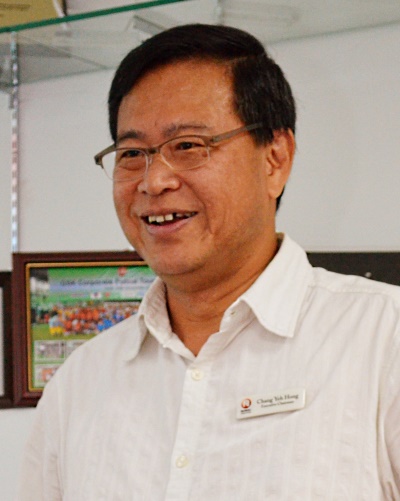
    ChangYehHong 8.15 It's unlikely they will drop off. These are all big multinationals --  our customer base are mostly blue chips and oil companies and semiconductor players. So it's unlikely that they will fall short in funding the projects.

    As for the maintenance segment, it is also safe in the sense that the plants have billions of dollars invested already. They need to be maintained.


     Q: What about competitors?


    Executive Chairman Chang Yeh Hong:There always will be competitors, right? What is more critical is how long have we been entrenched with the clients. Most of our maintenance contracts are more than 20 years. The track record is there and they continue with us if our price is right.

    We just got a maintenance contract for about $12 million from an oil major and we have been with this client for more than 20 years for two services. This time, they decided to combine the services into 1 package -- scaffolding, insulation and painting services. In the past, we got scaffolding on its own and installation on its own.

     Q: What are the greatest risks of your business?


    Executive Chairman Chang Yeh Hong:The greatest risk now is not related to the contracts that we have secured. Rather, it's inflationary pressures, particularly on labor and material. In services, the labor cost is critical to us, their dorm cost is critical to us because we have to house them.

    W
    e are very concerned about that but having said that, some of our businesses' margins are stable and unless inflationary pressures get out of hand I still think we will maintain our profitability provided we continue to get more contracts and it spreads the overhead costs.

    The FY2022 Powerpoint deck is here.  

    Nordic provides system integration solutions, repair and overhaul (MRO), precision engineering, scaffolding and insulation services, petrochemical and environmental engineering services and cleanroom, air and water engineering services. And there is Starburst, which has capital projects and maintenance contracts for the design, fabrication, installation and maintenance of anti-ricochet ballistic protection systems used in shooting ranges and tactical training mock-ups for the security industry in Singapore and Middle East.

  • It's only a matter of time before the semiconductor market recovers from the 2022/2023 major correction cycle which has seen  demand for PCs, smartphones, tablets and consumer electronics significantly decline.  Well, DBS Research is now calling for a recovery not too far in the future (excerpts below).

    LimEngHong 1.17CEO Lim Eng HongSo, time to pick up some semicon stocks? One Singapore-listed stock, Avi-Tech Holdings (market cap: S$45 million, net cash S$33 million, dividend yield 6.6%), has seen buying by its founder-CEO recently.

    And its most recent set of results --1HFY2023 (ended Dec 2022) -- were decent:

    • Revenue increased by 14.6% to $17.8 million; 
    • Gross profit margin was 25.7% (-2.1 ppt);
    • Net profit was unchanged at $2.0 million;
    • Interim dividend was unchanged at 0.75 cent/share.

    Share purchases by Lim Eng Hong, CEO of Avi-Tech 

    Date

    No. of shares

    Price

    Value

    Cumulative stake (%stake)

    8-Jun-2023

    204,700

    $0.25

    $51,175

    62,112,875
    (36.3%)

    6-Jun-2023

    354,900

    $0.25

    $88,725


    1-Jun-2023

    223,400

    $0.25

    $55,850


    Source: Company announcements


    Excerpts from DBS report

    Heading to the right side of U-shaped recovery 

    • Maintain our view of anticipated recovery in 2H23

    • Drivers for recovery:-

    1) Industry data bottoming;
    2) Lower inventory;
    3) AI to fuel growth;
    4) Green shoots from recent results release;
    5) SOX* as a leading indicator that the industry is intact 

    • AI market projected to register 2022-32 CAGR of 42%; direct beneficiaries are: Nvidia Corp, Marvell Tech, Broadcom, AMD, TSMC, Delta Electronics.

    • Asia tech are still laggard vs global peers; our picks are UMS Hldgs, BYD Electronic, Hua Hong Semiconductor

     The PHLX Semiconductor Sector (SOX) is a Philadelphia Stock Exchange capitalization-weighted index composed of the 30 largest U.S. companies primarily involved in the design, distribution, manufacture, and sale of semiconductors.

    Industry close to bottoming – are we on the left or right side of the U-shaped recovery?
    Recent semiconductor shipment data registered m-o-m growth after 14 consecutive months of decline, suggesting we are closer to bottoming now.

    Trade data from countries such as China, South Korea and Taiwan have shown clearer signs of stabilisation, though not yet a recovery. 

    Drivers for anticipated 2H23 recovery in place.
    These are:-

    1) Global semiconductor shipments nearing a bottom;
    2) Inventories are trending lower, removing a key obstacle;
    3) Pockets of optimism from recent results release;
    4) Artificial Intelligence (AI) to fuel recovery; and
    5) SOX continues to outperform the broad market. 

    Fast-growing AI benefitting the entire value chain
    Generative AI is expected to be a US$1.3trn market by 2032 (2022-32 CAGR of 42%) according to research from Bloomberg Intelligence.

    Potential beneficiaries are:

    (i) Equipment makers of machines that produce advanced chips,
    (ii) Foundries on higher orders/demand,
    (iii) Memory chips’ makers given the large datasets involved in generative AI,
    (iv) OSAT (outsourced semiconductor assembly and testing) as they benefit from increasingly complex assembly/testing. 

    Companies with direct exposure to AI are: Nvidia Corp, Marvell Tech, Broadcom, AMD, TSMC, Lenovo, Delta Electronics. 

    Asia tech still a laggard vs global peers.
    The PE valuation for SOX at c.30x is near the previous peak in 2021, but PEs for the Asian tech stocks under our coverage are still at or below the 5-year average.

    Our picks are UMS Hldgs, Hua Hong Semiconductor and BYD Electronics.


    Risks: Further demand weakness, deterioration of global economies, geopolitical and currency headwinds.

    Full report here. 


We have 1046 guests and no members online

rss_2 NextInsight - Latest News