

|
Deluge Corporation has delivered a strong first set of results since its October listing. For the six months ended Sept 2026:
*Excluding one-off IPO expenses.
Revenue jumped 54.9% to S$49.1 million, while segment profit before tax increased from just S$1.2 million to S$9.0 million. |
| Case by case |
Integrated Projects' gross margin reached about 29.8% in 1H, helped by variation orders and cost savings particularly as the Singapore-Johor Rapid Transit System project wound down.
Management said variation orders (VOs) are case-by-case.
In 1H, VOs and cost savings as the Johor Bahru–Singapore RTS Link approached completion helped lift Integrated Projects’ gross margin to 29.8%, above its normal 24%–25% range.
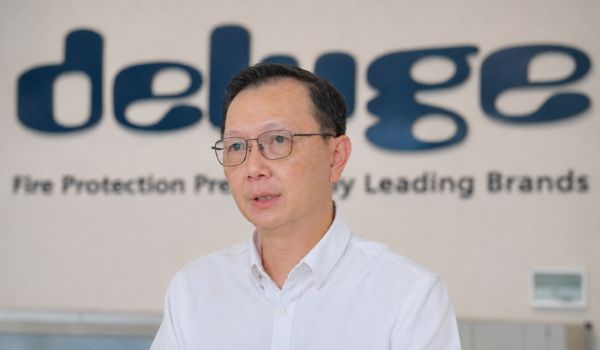 Deluge CEO Lee Wai Wah
Management said contract prices for projects in the order book are already locked in, while Deluge is becoming increasingly selective about new work amid margin pressure in the construction industry.
| Lifecycle Services had a quieter half |
Deluge’s Lifecycle Services segment is the after-sales part of the business.
After Deluge installs a fire-protection system, it can continue earning from the same building through maintenance, inspections, repairs, emergency work, system upgrades and additions & alterations (A&A) when tenants renovate or spaces are reconfigured.
 John Paul Chen, Group Strategy & Investments Director, DelugeLifecycle Services generated S$16.6 million of revenue and S$3.9 million of PBT.
Gross margin fell from around 53% to about 40%, below its historical 45%–50% range.
The reason was mainly timing: activity in higher-margin additions-and-alterations and ad-hoc maintenance work was quieter during the period.
Some such projects have already been secured for 2H, while others remain under tender.
| Order book continues to grow |
Despite the sharply higher project revenue, Deluge's order book stood at more than S$459.1 million as at 17 Nov, after securing more than S$147.7 million of new contracts since January across Singapore and Malaysia.
The latest awards span infrastructure, marine and offshore, residential and industrial projects, including a data centre project in Penang, demonstrating the breadth of the Group's capabilities and continued customer confidence in its engineering solutions.
Another potential catalyst is Changi Airport Terminal 5.
Management estimates the fire-protection tender comprises three packages worth an aggregate S$350 million–S$400 million.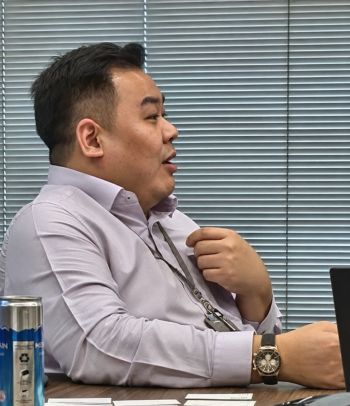 CFO Fredrik TanManagement's narrative on Deluge's competitive edge can be summed up as:
There are over 700 fire contractors in the market, but for bigger, complex jobs—like T5 —we are in a very good position. Only 8 contractors in Singapore hold the BCA ME06 L6 grading (unlimited tender limit). Very few of those L6 contractors have the track record, financial capability, and experience to handle mega-projects like Changi T5.
Results of the T5 tenders may be available in Q1 or Q2 2027, although actual work would likely commence only around 2028/29.
Deluge does not carry the same fixed-site exposure as a conventional civil contractor.
Management said its teams are mobilised only when construction sites are ready for fire-protection installation, while 30%–40% of its workforce can be outsourced during peak periods.
When one project is delayed, workers can be redeployed to another ready site.
This reduces the idle manpower and overhead burden typically associated with construction delays.
One caution is cash conversion. That may reverse as those projects progress.
Meanwhile, shareholders will receive a maiden 1.35-cent interim dividend, representing 25% of 1H attributable profit.
The investment thesis is no longer simply whether Deluge can grow. It is whether it can sustain normalised project margins, restore the Lifecycle business to historical margin levels and convert its S$459 million order book into cash and earnings — with T5 providing potentially substantial upside. |
 See the 3Q update here. See also: DELUGE: Big Projects First, High-Margin After-Sales For Years |
