
|
Excerpts from KGI report
Analyst: Chen Guangzhi
| Raffles Education: Undergoing a Multi-year Turnaround |
• Core Education segment normalisation with stronger unit economics. Raffles Education’s student enrolment stabilised above 22,000 in FY22–25, with the FY25 drop of ~4,800 students largely driven by strategic network rationalisation rather than demand weakness.
The Group shifted towards higher-value programmes, lifting average fees per student from below S$3,700 in FY23 to above S$5,000 in FY25, which helped offset the enrolment decline.
Operating metrics remain healthy: course fees/personnel cost stayed above 1.8×, while a 13.7% YoY rise in personnel expenses—well above typical salary increments—signals active headcount expansion to support growth.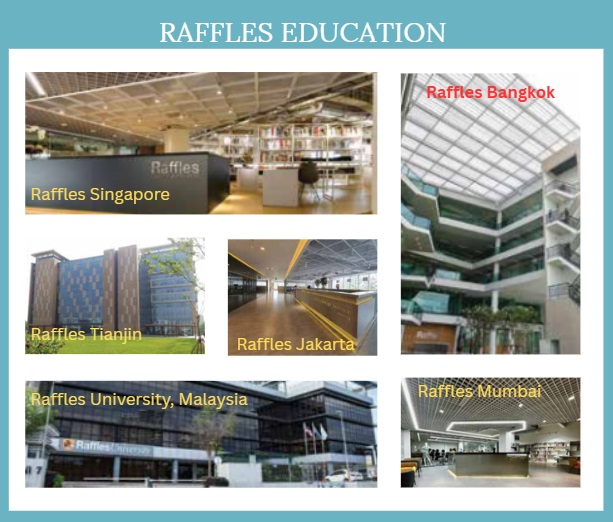
• Refined geographic focus: expanding ASEAN, reducing China exposure. ASEAN course-fee revenue grew from S$30.1m in FY2021 to S$46.9m in FY2025, supported by resilient demand for its K12 and higher-education programmes, including the 500 students in Raffles American School Johor.
In contrast, North Asia revenue fell from S$54.6m to S$40.6mn as the Group intentionally scaled back its China footprint through campus rationalisation and exits from lower-margin operations.
This strategic rebalancing positions Raffles Education more squarely in ASEAN’s structurally high-growth private-education market.
• Balance-sheet repair gaining traction through lower gearing and falling interest costs. Profitability has long been constrained by thin interest coverage, but the environment is turning supportive as global rates fall and the Group actively deleverages.
Key initiatives include monetising low yielding core and non-core assets—the proposed disposal of Wanbo College announced on 26 November and the
proposed S$121.8m sale of 51 Merchant Road announced on 1 December—to repay major secured loans, as well as converting approximately S$15.5m of insider funding into equity.
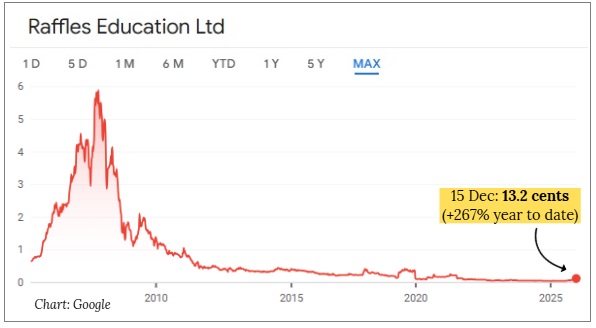
With the recent surge in share price, the convertible bonds are now effectively equity; holders are incentivised to convert, given the opportunity to more than double their initial investment.
Beyond the convertible bonds, further balance-sheet repair is expected through continued asset divestments and debt-to-equity conversions, collectively
positioning the Group for a structurally lower interest burden and a more sustainable capital structure.
• Attractive asset-value arbitrage from undervalued real estate portfolio. Raffles Education owns sizable rental generating and owner-occupied properties across Singapore, Malaysia, Indonesia, Thailand and China that are carried at historical cost, contributing to its depressed P/NTA.
The rental assets alone are worth roughly the Group’s entire market cap, implying investors are effectively getting the core education business and remaining land bank for free — offering a wide margin of safety.
Furthermore, the market has yet recognized the value of its intangible assets such as university and colleges licences which the company owns in various countries and the brand name of "Raffles Education".
We initiate Raffles Education with an OUTPERFORM recommendation at a fully diluted TP of S$0.34 and a current TP of S$0.54 using a DCF valuation methodology with a WACC of 8.0% and a terminal growth rate of 2.5%.  Chen Guangzhi, analystGiven the decline in debt levels and lower interest rates, should the Group’s profitability improve substantially onwards with potential increase in school fees. Chen Guangzhi, analystGiven the decline in debt levels and lower interest rates, should the Group’s profitability improve substantially onwards with potential increase in school fees.Outlook: Raffles Education will focus its expansion efforts on ASEAN markets, particularly in Malaysia, Indonesia, and Thailand. The Group is expected to emerge largely debt-free, except for approximately S$20mn of debt at the OUCHK level. OUCHK is a separately listed entity on the HKEX. With the substantial reduction in borrowings, the resulting interest savings will be significant. The Company also plans to re-establish a dividend policy, which will reward shareholders and further strengthen the alignment between management and shareholder interests. |
Risks: The student enrolment decline in FY25 highlights ongoing demand volatility amid competitive and cyclical pressures.
Operating across multiple jurisdictions also exposes the Group to regulatory shifts, while rising staff costs, inflation, and currency movements pose margin risks.
Finally, the business remains highly dependent on brand reputation, where any deterioration in perceived quality could materially impact pricing power and future enrolment. → Full report here.


